


Free 14-Day Trial
Perform unlimited ergonomic assessments for two weeks. All you need is your phone.


There is no single “best” ergonomic assessment method — there’s a right one for the task in front of you. A whole-body lifting motion, a repetitive wrist-intensive job, and a two-handed pallet lift each call for a different tool, because each method was designed around a specific set of body regions and risk factors. Pick the wrong one and you can get a clean score on a job that’s actually hurting people.
This guide compares the five methods safety teams reach for most — REBA, RULA, the Revised NIOSH Lifting Equation, the Revised Strain Index (RSI), and Snook Tables — so you can match the method to the task. At the bottom we cover how to run any of them faster and more consistently from a phone video.
Download our assessment types cheat sheet here
Measures: the entire body.
Best for: static and dynamic whole-body activities — lifting, bending, reaching, and pushing/pulling.
REBA scores posture as the main risk factor, with force, repetition, and duration as secondary inputs, and returns a single risk level from 1 to 15. Because it covers the whole body and handles dynamic motion, it’s the go-to screening tool when a task involves the trunk, legs, and arms together rather than one isolated region.
Measures: the upper limbs — neck, shoulders, arms, hands/wrists, and trunk.
Best for: static (sitting or standing) or repetitive work.
RULA also treats posture as the main factor, with force and repetition secondary, but it does not consider duration, and it returns a tighter risk level from 1 to 7. It shines on seated or upper-body-driven jobs — assembly, packing, workstation and computer work — where the legs aren’t the concern but neck, shoulder, and wrist posture are.
REBA and RULA are screening tools. Use them to determine whether a risk is present. If you need deeper, more quantitative analysis, move to the Revised NIOSH Lifting Equation or the Revised Strain Index.
Measures: primarily the trunk and lower back, with hands/wrists, legs, and shoulders/arms as secondary regions.
Best for: lifting and lowering tasks with stable loads.
NIOSH flips the priority order: force, repetition, and duration are the main factors, with posture secondary. Instead of a simple risk grade, it outputs a Recommended Weight Limit (RWL) — the weight that can be safely handled given the conditions of that specific task over a substantial period (up to 8 hours) — and a Lifting Index (LI) that expresses the risk of a low-back injury. It’s the quantitative standard for two-handed lifting jobs.
Measures: primarily the hands and wrist, with the lower arm as a secondary region.
Best for: repetitive hand-intensive work — gripping, twisting, grasping, and working with hand tools.
RHSI weighs force, repetition, duration, and posture together to estimate the risk of an MSD in the hands, wrists, forearm, or elbow. When a job is defined by what the hands are doing all day — not whole-body posture — RSI gives a far more meaningful answer than a general posture tool.
Measures: the entire body.
Best for: manual material handling — lifting/lowering, pushing/pulling, and carrying.
Where the other methods score an existing task, Snook Tables are built for design: they give acceptable weights and forces (based on the percentage of the working population that can perform the task without overexertion) so you can engineer a manual handling job to be safe in the first place. Force and repetition are the main factors, with duration and posture secondary.
A practical workflow: screen broadly with REBA or RULA, and when a screen flags a risk, follow up with the quantitative tool that matches the task — NIOSH for lifting, RSI for hand-intensive work, Snook for designing the handling task.
These methods are validated and widely accepted — the weakness isn’t the math, it’s how the inputs are usually gathered. Traditionally, an assessor estimates joint angles by eye from a few minutes of observation, scores one “representative” posture, and writes it up. That single-snapshot, subjective process is slow, varies from one assessor to the next, and only ever covers the handful of tasks someone had time to watch.
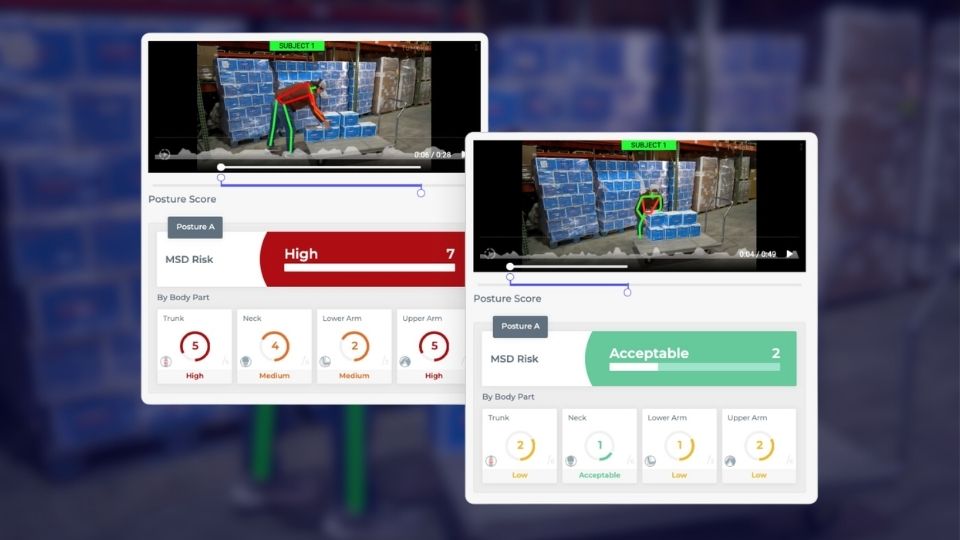
This is where automation changes the picture. TuMeke’s Risk Suite turns a phone video into an automated ergonomic risk assessment — applying RULA, REBA, and NIOSH scoring to the full motion, frame by frame, with no wearables. The same validated methods, run the same way every time, fast enough to assess every task across every site instead of spot-checking a few.
What is the difference between REBA and RULA? REBA (Rapid Entire Body Assessment) evaluates the entire body and is suited to dynamic whole-body tasks like lifting and pushing/pulling, scoring risk from 1 to 15. RULA (Rapid Upper Limb Assessment) focuses on the upper limbs — neck, shoulders, arms, wrists, and trunk — for static or repetitive work, scoring from 1 to 7. RULA does not factor in duration; REBA does.
Which ergonomic assessment is best for lifting tasks? The Revised NIOSH Lifting Equation is the standard for two-handed lifting and lowering of stable loads. It produces a Recommended Weight Limit (RWL) and a Lifting Index (LI) that quantify low-back injury risk. For designing a lifting, pushing, pulling, or carrying task, Snook Tables (Liberty Mutual equations) give acceptable weights and forces.
Which method should I use for repetitive hand and wrist work? The Revised Strain Index (RSI) is built for repetitive hand-intensive jobs — gripping, twisting, grasping, and using hand tools. It estimates the risk of a musculoskeletal disorder in the hands, wrists, forearm, or elbow, weighing force, repetition, duration, and posture.
Are REBA and RULA enough on their own? REBA and RULA are preliminary screening tools that tell you whether an ergonomic risk is present. If a screen flags a risk and you need deeper analysis, follow up with a quantitative tool such as the Revised NIOSH Lifting Equation or the Revised Strain Index.
Can ergonomic assessments be automated? Yes. Computer-vision platforms like TuMeke’s Risk Suite apply RULA, REBA, and NIOSH scoring to a phone video automatically — measuring the full motion frame by frame rather than scoring a single observed posture, which removes inter-rater variability and makes it practical to assess far more tasks.
%201.svg)


.jpg)

.jpg)

There is no single “best” ergonomic assessment method — there’s a right one for the task in front of you. A whole-body lifting motion, a repetitive wrist-intensive job, and a two-handed pallet lift each call for a different tool, because each method was designed around a specific set of body regions and risk factors. Pick the wrong one and you can get a clean score on a job that’s actually hurting people.
This guide compares the five methods safety teams reach for most — REBA, RULA, the Revised NIOSH Lifting Equation, the Revised Strain Index (RSI), and Snook Tables — so you can match the method to the task. At the bottom we cover how to run any of them faster and more consistently from a phone video.
Download our assessment types cheat sheet here
Measures: the entire body.
Best for: static and dynamic whole-body activities — lifting, bending, reaching, and pushing/pulling.
REBA scores posture as the main risk factor, with force, repetition, and duration as secondary inputs, and returns a single risk level from 1 to 15. Because it covers the whole body and handles dynamic motion, it’s the go-to screening tool when a task involves the trunk, legs, and arms together rather than one isolated region.
Measures: the upper limbs — neck, shoulders, arms, hands/wrists, and trunk.
Best for: static (sitting or standing) or repetitive work.
RULA also treats posture as the main factor, with force and repetition secondary, but it does not consider duration, and it returns a tighter risk level from 1 to 7. It shines on seated or upper-body-driven jobs — assembly, packing, workstation and computer work — where the legs aren’t the concern but neck, shoulder, and wrist posture are.
REBA and RULA are screening tools. Use them to determine whether a risk is present. If you need deeper, more quantitative analysis, move to the Revised NIOSH Lifting Equation or the Revised Strain Index.
Measures: primarily the trunk and lower back, with hands/wrists, legs, and shoulders/arms as secondary regions.
Best for: lifting and lowering tasks with stable loads.
NIOSH flips the priority order: force, repetition, and duration are the main factors, with posture secondary. Instead of a simple risk grade, it outputs a Recommended Weight Limit (RWL) — the weight that can be safely handled given the conditions of that specific task over a substantial period (up to 8 hours) — and a Lifting Index (LI) that expresses the risk of a low-back injury. It’s the quantitative standard for two-handed lifting jobs.
Measures: primarily the hands and wrist, with the lower arm as a secondary region.
Best for: repetitive hand-intensive work — gripping, twisting, grasping, and working with hand tools.
RHSI weighs force, repetition, duration, and posture together to estimate the risk of an MSD in the hands, wrists, forearm, or elbow. When a job is defined by what the hands are doing all day — not whole-body posture — RSI gives a far more meaningful answer than a general posture tool.
Measures: the entire body.
Best for: manual material handling — lifting/lowering, pushing/pulling, and carrying.
Where the other methods score an existing task, Snook Tables are built for design: they give acceptable weights and forces (based on the percentage of the working population that can perform the task without overexertion) so you can engineer a manual handling job to be safe in the first place. Force and repetition are the main factors, with duration and posture secondary.
A practical workflow: screen broadly with REBA or RULA, and when a screen flags a risk, follow up with the quantitative tool that matches the task — NIOSH for lifting, RSI for hand-intensive work, Snook for designing the handling task.
These methods are validated and widely accepted — the weakness isn’t the math, it’s how the inputs are usually gathered. Traditionally, an assessor estimates joint angles by eye from a few minutes of observation, scores one “representative” posture, and writes it up. That single-snapshot, subjective process is slow, varies from one assessor to the next, and only ever covers the handful of tasks someone had time to watch.
This is where automation changes the picture. TuMeke’s Risk Suite turns a phone video into an automated ergonomic risk assessment — applying RULA, REBA, and NIOSH scoring to the full motion, frame by frame, with no wearables. The same validated methods, run the same way every time, fast enough to assess every task across every site instead of spot-checking a few.
What is the difference between REBA and RULA? REBA (Rapid Entire Body Assessment) evaluates the entire body and is suited to dynamic whole-body tasks like lifting and pushing/pulling, scoring risk from 1 to 15. RULA (Rapid Upper Limb Assessment) focuses on the upper limbs — neck, shoulders, arms, wrists, and trunk — for static or repetitive work, scoring from 1 to 7. RULA does not factor in duration; REBA does.
Which ergonomic assessment is best for lifting tasks? The Revised NIOSH Lifting Equation is the standard for two-handed lifting and lowering of stable loads. It produces a Recommended Weight Limit (RWL) and a Lifting Index (LI) that quantify low-back injury risk. For designing a lifting, pushing, pulling, or carrying task, Snook Tables (Liberty Mutual equations) give acceptable weights and forces.
Which method should I use for repetitive hand and wrist work? The Revised Strain Index (RSI) is built for repetitive hand-intensive jobs — gripping, twisting, grasping, and using hand tools. It estimates the risk of a musculoskeletal disorder in the hands, wrists, forearm, or elbow, weighing force, repetition, duration, and posture.
Are REBA and RULA enough on their own? REBA and RULA are preliminary screening tools that tell you whether an ergonomic risk is present. If a screen flags a risk and you need deeper analysis, follow up with a quantitative tool such as the Revised NIOSH Lifting Equation or the Revised Strain Index.
Can ergonomic assessments be automated? Yes. Computer-vision platforms like TuMeke’s Risk Suite apply RULA, REBA, and NIOSH scoring to a phone video automatically — measuring the full motion frame by frame rather than scoring a single observed posture, which removes inter-rater variability and makes it practical to assess far more tasks.
.jpg)