


Free 14-Day Trial
Perform unlimited ergonomic assessments for two weeks. All you need is your phone.


Key Takeaway
Video is reshaping ergonomic investigations because it captures how work actually happens. It helps teams see posture, repetition, and task demands with more clarity than interviews alone. This leads to more accurate root cause analysis and smarter decisions. Over time, it helps prevent injuries across jobs and sites.
Most ergonomic investigations begin with the same tools: employee interviews, incident notes, and a supervisor summary. Those steps matter, but they rarely capture the physical reality of the job across an entire shift.
People naturally shorten the story when they explain their work. They describe the task as the standard process, not the version shaped by production pressure, fatigue, line backups, changing product mix, or end-of-shift shortcuts.
Take a common warehouse task. Someone says, “I lift boxes and stack pallets.” On paper, that sounds routine.
In practice, the lift changes hour by hour:
Those changing conditions often drive the real exposure, yet they rarely make it into a written statement.
Supervisor summaries can miss risk for a different reason. Experienced leaders often normalize what they see every day, so awkward reaches, fast hand motions, or repeated bending start to look like part of the job instead of warning signs.
That’s why interviews and reports should inform an investigation, not carry it. They provide useful context, but they seldom document the full pattern of force, posture, repetition, and variability that leads to musculoskeletal strain.
When the real exposure never makes it into the report, the impact usually shows up later in injury rates, lost time, and avoidable costs.
Ergonomic injuries still create a major operational and financial burden for U.S. employers. They drive lost productivity, overtime, retraining, workers’ compensation costs, and staffing disruption that can linger long after the initial case.
Recent data from the U.S. Bureau of Labor Statistics shows how large the impact remains in private industry during 2024:
The pattern becomes clearer when you look at what drives serious cases. In the BLS report on employer-reported workplace injuries and illnesses, the highest number of DART cases across 2023 to 2024 came from overexertion, repetitive motion, and bodily conditions.
That matters because these incidents often stem from routine job demands, not unusual events. When tasks involve repeated force, awkward posture, poor layout, or high pace, the same exposures can keep generating injuries until the job itself changes. Employers need a better way to see job demands before they turn into the next recordable case.
Video strengthens an investigation because it creates a permanent record of the task. Teams can review the same job cycle multiple times, slow it down, compare sequences, and study details that are easy to miss in real time.
That repeatability matters when several groups are involved. Safety, operations, supervisors, and ergonomics specialists can all assess the same footage instead of working from separate recollections.
Video also supports more consistent exposure analysis, including:
It also helps confirm whether corrective actions actually improved the job. Teams can compare footage before and after changes to layout, tools, staffing, or workstation design to see if exposure levels truly dropped.
Worker input still plays an important role. Employees explain fatigue, discomfort, staffing pressure, and production realities, while video gives the team a shared factual record they can use to make better decisions. Seeing the work more clearly is valuable, but the real payoff comes when that visibility turns into faster fixes and better prevention.
Seeing risk is only the first step. The real challenge is turning video into clear decisions that reduce injuries, improve jobs, and hold up across multiple sites. That’s where TuMeke helps
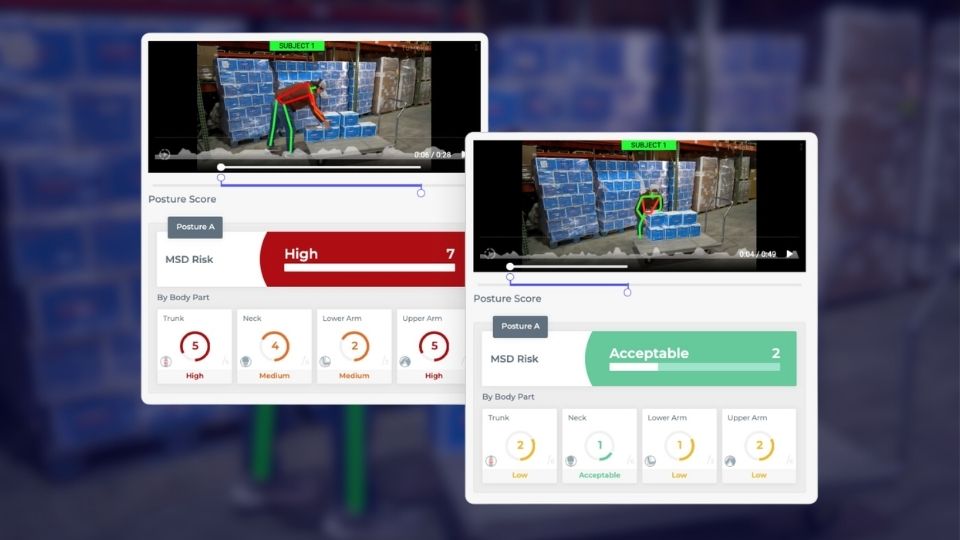
TuMeke turns simple smartphone video into fast, consistent ergonomic assessments so safety and operations teams can move from observation to action without waiting on slow manual reviews or expensive hardware.
With TuMeke, teams can:
TuMeke gives leaders one clear view of what is happening, where action is needed, and how improvements are tracking over time. Instead of waiting for the next injury report, you can act earlier, fix smarter, and build safer work at scale.
See how TuMeke can help your team uncover hidden risks and take action faster. Book a demo today.
What is the best way to investigate repetitive strain injuries at work?
The best approach combines employee input, task observation, and video review. Video helps teams see repetition rate, reach distance, posture, and pace changes that are hard to capture through interviews alone, which supports a stronger root cause analysis.
Does OSHA require employers to use video in ergonomic investigations?
No, federal OSHA does not require video for ergonomic investigations. Employers still have a duty to identify and address recognized hazards, and video can help document job demands more accurately as part of a broader ergonomics process.
How can video help reduce musculoskeletal disorder risks?
Video helps reduce musculoskeletal disorder risks by showing where awkward posture, forceful exertion, and repeated motion occur during real work. Once teams can see those exposures clearly, they can redesign tasks, improve layouts, and target training more effectively.
What jobs benefit most from video ergonomic analysis?
Jobs with frequent lifting, repetitive motion, or fast-paced manual work often benefit the most. Warehousing, manufacturing, food processing, logistics, airlines, and material handling roles commonly use video analysis to uncover hidden strain risks.
Can AI improve ergonomic investigations?
Yes, AI can speed up ergonomic investigations by analyzing movement patterns in video and highlighting higher-risk tasks sooner. This helps safety teams review more jobs, prioritize fixes, and create more consistent assessments across departments or multiple sites.
%201.svg)


.jpg)

.jpg)

Key Takeaway
Video is reshaping ergonomic investigations because it captures how work actually happens. It helps teams see posture, repetition, and task demands with more clarity than interviews alone. This leads to more accurate root cause analysis and smarter decisions. Over time, it helps prevent injuries across jobs and sites.
Most ergonomic investigations begin with the same tools: employee interviews, incident notes, and a supervisor summary. Those steps matter, but they rarely capture the physical reality of the job across an entire shift.
People naturally shorten the story when they explain their work. They describe the task as the standard process, not the version shaped by production pressure, fatigue, line backups, changing product mix, or end-of-shift shortcuts.
Take a common warehouse task. Someone says, “I lift boxes and stack pallets.” On paper, that sounds routine.
In practice, the lift changes hour by hour:
Those changing conditions often drive the real exposure, yet they rarely make it into a written statement.
Supervisor summaries can miss risk for a different reason. Experienced leaders often normalize what they see every day, so awkward reaches, fast hand motions, or repeated bending start to look like part of the job instead of warning signs.
That’s why interviews and reports should inform an investigation, not carry it. They provide useful context, but they seldom document the full pattern of force, posture, repetition, and variability that leads to musculoskeletal strain.
When the real exposure never makes it into the report, the impact usually shows up later in injury rates, lost time, and avoidable costs.
Ergonomic injuries still create a major operational and financial burden for U.S. employers. They drive lost productivity, overtime, retraining, workers’ compensation costs, and staffing disruption that can linger long after the initial case.
Recent data from the U.S. Bureau of Labor Statistics shows how large the impact remains in private industry during 2024:
The pattern becomes clearer when you look at what drives serious cases. In the BLS report on employer-reported workplace injuries and illnesses, the highest number of DART cases across 2023 to 2024 came from overexertion, repetitive motion, and bodily conditions.
That matters because these incidents often stem from routine job demands, not unusual events. When tasks involve repeated force, awkward posture, poor layout, or high pace, the same exposures can keep generating injuries until the job itself changes. Employers need a better way to see job demands before they turn into the next recordable case.
Video strengthens an investigation because it creates a permanent record of the task. Teams can review the same job cycle multiple times, slow it down, compare sequences, and study details that are easy to miss in real time.
That repeatability matters when several groups are involved. Safety, operations, supervisors, and ergonomics specialists can all assess the same footage instead of working from separate recollections.
Video also supports more consistent exposure analysis, including:
It also helps confirm whether corrective actions actually improved the job. Teams can compare footage before and after changes to layout, tools, staffing, or workstation design to see if exposure levels truly dropped.
Worker input still plays an important role. Employees explain fatigue, discomfort, staffing pressure, and production realities, while video gives the team a shared factual record they can use to make better decisions. Seeing the work more clearly is valuable, but the real payoff comes when that visibility turns into faster fixes and better prevention.
Seeing risk is only the first step. The real challenge is turning video into clear decisions that reduce injuries, improve jobs, and hold up across multiple sites. That’s where TuMeke helps
TuMeke turns simple smartphone video into fast, consistent ergonomic assessments so safety and operations teams can move from observation to action without waiting on slow manual reviews or expensive hardware.
With TuMeke, teams can:
TuMeke gives leaders one clear view of what is happening, where action is needed, and how improvements are tracking over time. Instead of waiting for the next injury report, you can act earlier, fix smarter, and build safer work at scale.
See how TuMeke can help your team uncover hidden risks and take action faster. Book a demo today.
What is the best way to investigate repetitive strain injuries at work?
The best approach combines employee input, task observation, and video review. Video helps teams see repetition rate, reach distance, posture, and pace changes that are hard to capture through interviews alone, which supports a stronger root cause analysis.
Does OSHA require employers to use video in ergonomic investigations?
No, federal OSHA does not require video for ergonomic investigations. Employers still have a duty to identify and address recognized hazards, and video can help document job demands more accurately as part of a broader ergonomics process.
How can video help reduce musculoskeletal disorder risks?
Video helps reduce musculoskeletal disorder risks by showing where awkward posture, forceful exertion, and repeated motion occur during real work. Once teams can see those exposures clearly, they can redesign tasks, improve layouts, and target training more effectively.
What jobs benefit most from video ergonomic analysis?
Jobs with frequent lifting, repetitive motion, or fast-paced manual work often benefit the most. Warehousing, manufacturing, food processing, logistics, airlines, and material handling roles commonly use video analysis to uncover hidden strain risks.
Can AI improve ergonomic investigations?
Yes, AI can speed up ergonomic investigations by analyzing movement patterns in video and highlighting higher-risk tasks sooner. This helps safety teams review more jobs, prioritize fixes, and create more consistent assessments across departments or multiple sites.
.jpg)