


Free 14-Day Trial
Perform unlimited ergonomic assessments for two weeks. All you need is your phone.


At TuMeke, we’ve always believed ergonomic risk is about more than posture alone.
Posture matters, of course. But anyone who has spent time analyzing real-world work knows that posture is only one part of the equation. Risk is also shaped by repetition, duration, force, grip, balance, and the context of the job itself. At the same time, most ergonomics workflows still rely on manual inputs and scoring steps that slow teams down and make assessments harder to scale.
This is the gap we’ve been working to close.
Today, we're excited to share the next generation of Risk Suite, a major step forward in AI Ergonomics built around two important advancements: Fully Automated Assessments and Movement Analysis Beyond Posture.
For years, ergonomics technology has helped teams digitize assessments and move faster than purely manual methods. That has been meaningful progress. But in many cases, the workflow still depends on subjective inputs, manual interpretation, and narrow analysis focused mostly on posture.
We don’t think this is enough.
If the goal is to help organizations assess risk accurately, consistently, and at scale, the technology has to do more. It has to reduce manual work, not just reorganize it. And it has to analyze more of the factors that actually drive risk in the real world.
That is the mission behind this release.
The first major advancement in this release is Fully Automated Assessments.
This means Risk Suite removes the manual inputs and scoring steps that have historically slowed ergonomic assessments down. Instead of asking users to fill in the gaps, the system does more of the work automatically.
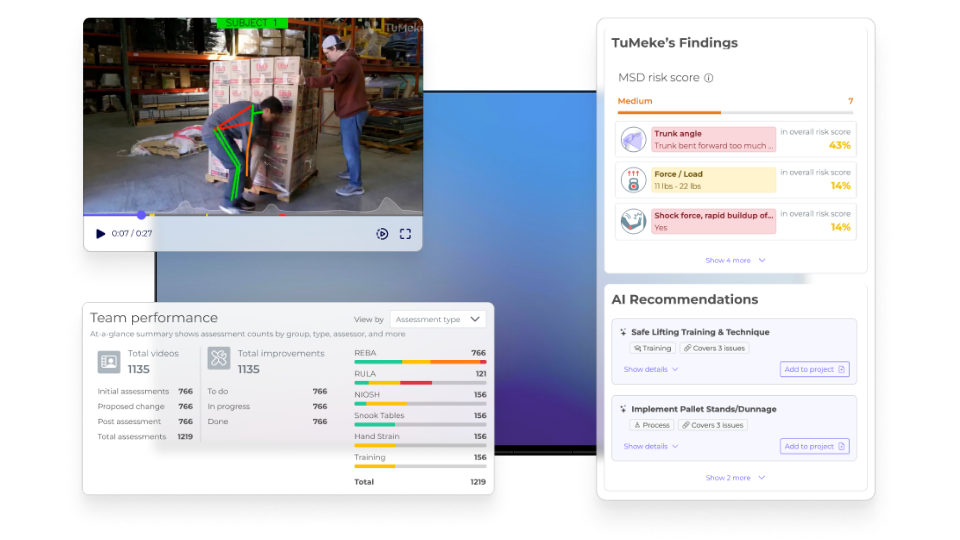
That matters for a few reasons.
The second major advancement is Movement Analysis Beyond Posture.
As mentioned earlier, posture is only one part of ergonomic risk. With this release, Risk Suite expands analysis to include:
This gives teams a more complete view of what’s actually happening in a task and what may be contributing to risk.
This is especially important because real-world work is dynamic. A posture snapshot alone does not always explain why a task is risky, how it should be prioritized, or what needs to change. By analyzing a broader set of factors, we can help teams understand work more completely and make better decisions about where to focus.
From a technology perspective, this release reflects a lot of work across computer vision, modeling, product design, and workflow simplification.
It’s one thing to identify posture from video. It’s another to build a system that can automatically interpret more of the task, reduce dependence on manual inputs, and deliver results in a way that is practical for real safety teams.
That has been our focus from the beginning. The goal has never been to build technology that is impressive in isolation, but hard to apply in the field. We want to build tools that make ergonomics analysis faster, easier, more intuitive, and more scalable for the people doing the work every day.
For our customers, the next generation of Risk Suite means a better way to assess ergonomic risk.
It means less time spent on manual steps.
It means a more intuitive workflow.
It means a broader and more useful understanding of what is driving risk in a task.
And ultimately, it means a platform that is better suited to the realities of large-scale ergonomics programs, where speed, consistency, usability, and completeness all matter.
We see this launch as a major step forward, but not the end point.
The broader opportunity in front of us is to help organizations better understand human movement, assess risk more intelligently, and turn that understanding into safer work and better outcomes.
The next generation of Risk Suite moves us meaningfully in that direction.
We’re excited to share more in the weeks ahead, and even more excited to see what our customers do with it.
If you’d like to learn more, request a demo or join our upcoming webinar. We’d love to show you what’s new.
%201.svg)


.jpg)

.jpg)
.jpg)

At TuMeke, we’ve always believed ergonomic risk is about more than posture alone.
Posture matters, of course. But anyone who has spent time analyzing real-world work knows that posture is only one part of the equation. Risk is also shaped by repetition, duration, force, grip, balance, and the context of the job itself. At the same time, most ergonomics workflows still rely on manual inputs and scoring steps that slow teams down and make assessments harder to scale.
This is the gap we’ve been working to close.
Today, we're excited to share the next generation of Risk Suite, a major step forward in AI Ergonomics built around two important advancements: Fully Automated Assessments and Movement Analysis Beyond Posture.
For years, ergonomics technology has helped teams digitize assessments and move faster than purely manual methods. That has been meaningful progress. But in many cases, the workflow still depends on subjective inputs, manual interpretation, and narrow analysis focused mostly on posture.
We don’t think this is enough.
If the goal is to help organizations assess risk accurately, consistently, and at scale, the technology has to do more. It has to reduce manual work, not just reorganize it. And it has to analyze more of the factors that actually drive risk in the real world.
That is the mission behind this release.
The first major advancement in this release is Fully Automated Assessments.
This means Risk Suite removes the manual inputs and scoring steps that have historically slowed ergonomic assessments down. Instead of asking users to fill in the gaps, the system does more of the work automatically.
That matters for a few reasons.
The second major advancement is Movement Analysis Beyond Posture.
As mentioned earlier, posture is only one part of ergonomic risk. With this release, Risk Suite expands analysis to include:
This gives teams a more complete view of what’s actually happening in a task and what may be contributing to risk.
This is especially important because real-world work is dynamic. A posture snapshot alone does not always explain why a task is risky, how it should be prioritized, or what needs to change. By analyzing a broader set of factors, we can help teams understand work more completely and make better decisions about where to focus.
From a technology perspective, this release reflects a lot of work across computer vision, modeling, product design, and workflow simplification.
It’s one thing to identify posture from video. It’s another to build a system that can automatically interpret more of the task, reduce dependence on manual inputs, and deliver results in a way that is practical for real safety teams.
That has been our focus from the beginning. The goal has never been to build technology that is impressive in isolation, but hard to apply in the field. We want to build tools that make ergonomics analysis faster, easier, more intuitive, and more scalable for the people doing the work every day.
For our customers, the next generation of Risk Suite means a better way to assess ergonomic risk.
It means less time spent on manual steps.
It means a more intuitive workflow.
It means a broader and more useful understanding of what is driving risk in a task.
And ultimately, it means a platform that is better suited to the realities of large-scale ergonomics programs, where speed, consistency, usability, and completeness all matter.
We see this launch as a major step forward, but not the end point.
The broader opportunity in front of us is to help organizations better understand human movement, assess risk more intelligently, and turn that understanding into safer work and better outcomes.
The next generation of Risk Suite moves us meaningfully in that direction.
We’re excited to share more in the weeks ahead, and even more excited to see what our customers do with it.
If you’d like to learn more, request a demo or join our upcoming webinar. We’d love to show you what’s new.