


Free 14-Day Trial
Perform unlimited ergonomic assessments for two weeks. All you need is your phone.

.png)
Electronics manufacturing ergonomics can be easy to underestimate. Small components, seated work, and orderly workstations may look low-risk during a floor walk, even when workers repeat demanding hand motions throughout the shift.
Low part weight doesn’t mean low physical exposure. Risk often comes from the combined dose of pinch or insertion force, repetition, wrist position, static loading, production pace, and limited recovery. Safety and operations teams need to examine what workers repeatedly do to the part, not just what the part weighs.
This article identifies the electronics jobs that deserve closer review, explains why posture-focused assessments may miss the dominant exposure, and outlines a more useful assessment and control process.
A small part can still require a surprising amount of physical effort. Workers may need to pinch, press, align, stabilize, or insert components thousands of times during a shift.
NIOSH identifies force, repetition, and awkward posture as major ergonomic stressors. The level of risk depends on how much effort the task requires, how often the worker repeats it, and how long the exposure continues. NIOSH’s Upper Limb Musculoskeletal Disorder Consortium also found hand force to be the strongest and most consistent biomechanical risk factor in its pooled research.
Connector insertion is a good example. In an older NIOSH study of appliance wiring, workers sometimes connected up to five wires during a 20-second cycle. Inserting the terminals required an average of 12 to 32 pounds of force, depending on the wire size.
Static work creates a different type of exposure. A soldering technician may hold a light tool with little visible movement, but still maintain a precision grip, unsupported forearms, and a fixed neck position while working under magnification.
No single electronics job is always the highest risk. Priority depends on the exposure combination, production conditions, and time spent on the task.
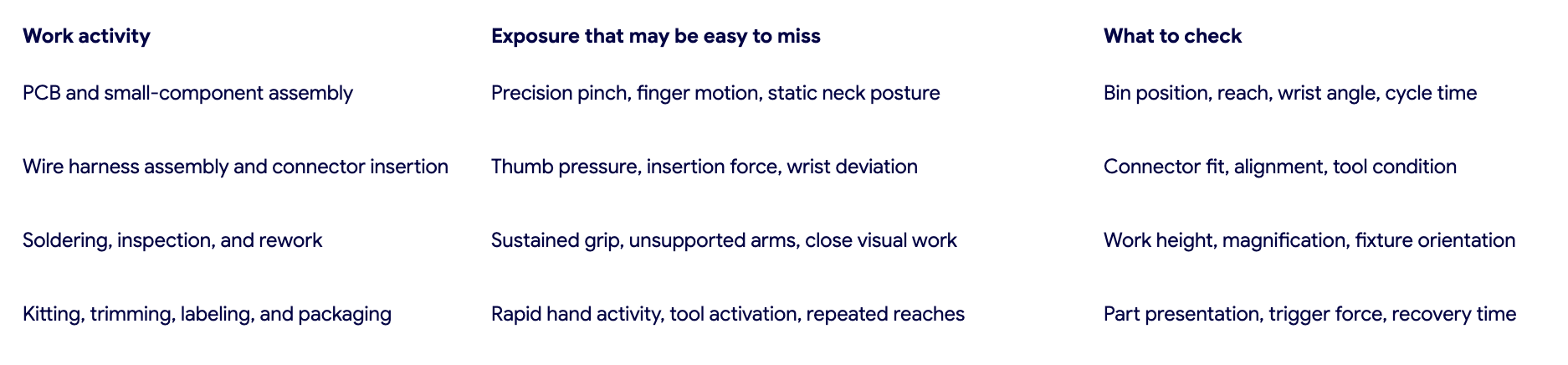
Rework deserves separate attention. A production station may provide predictable orientation and stable fixtures, while a rework technician deals with restricted access, variable task length, and less favorable tool angles.
Posture methods can identify bent wrists, elevated shoulders, neck flexion, and other important concerns. They may not fully answer how hard, how often, or how long the hands exert force.
A worker can appear upright with the elbows close to the body while repeatedly pressing a connector with the thumb. Another may use an acceptable shoulder posture but maintain a precision pinch for most of the cycle. A short posture snapshot won’t show the total hand activity or recovery pattern.
The assessment method should match the physical question. RULA can help screen upper-limb posture, while the Revised Strain Index focuses on hand-intensive work involving factors such as exertion intensity, repetition, duration, and wrist position.
Posture assessment still has value. However, posture alone may not show the full exposure when the dominant demand sits in the hands, wrists, or forearms.
A clean recording of one experienced assembler completing one normal cycle may produce a neat assessment and a weak conclusion. The assessment should show how the job is actually performed under normal production conditions.
For electronics work, ask:
Observe more than one worker when possible. An experienced operator may use a lower-effort technique that a new, shorter, taller, or left-handed employee cannot duplicate.
The strongest controls change the work condition driving the exposure. OSHA’s ergonomics guidance identifies engineering controls as the preferred approach where feasible.
Depending on the task, useful changes may include:
Job rotation needs the same scrutiny. Moving someone from connector insertion to lead clipping may change the job name while preserving rapid pinch, wrist deviation, and static upper-body loading. Compare the exposure profile of each job before treating the schedule as recovery.
Controls can also shift the problem. Raising a fixture may reduce neck flexion while increasing shoulder elevation. Reassess the modified task to confirm that the change lowered the intended exposure without creating another one.
Assessing one station is manageable. Comparing repetitive assembly, wiring, soldering, inspection, and rework across several lines or facilities creates a larger consistency and documentation problem.
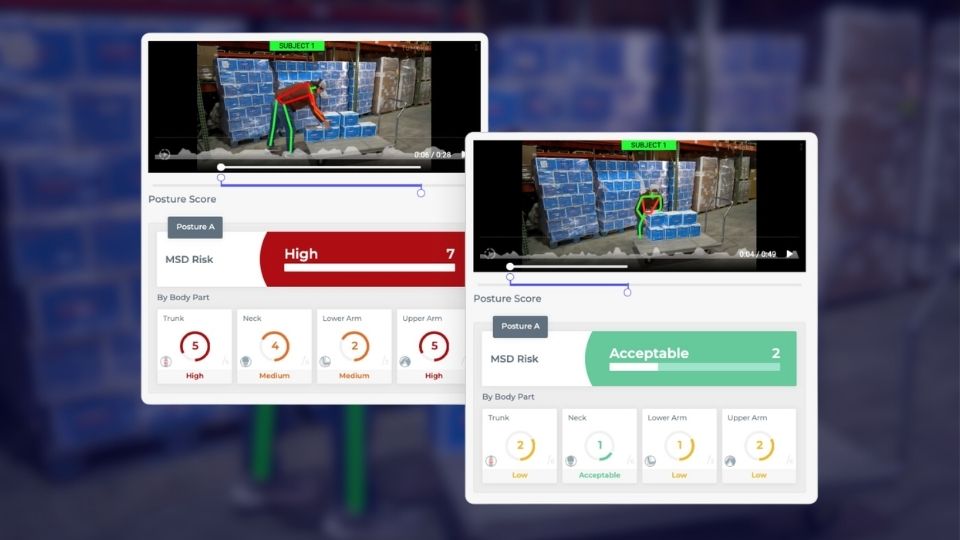
TuMeke Risk Suite uses video-based ergonomic assessments and analyzes factors including posture, repetition, duration, job context, grip, force, and balance. For electronics manufacturing teams, that supports several uses:
Book a TuMeke demo to review how your team could assess repetitive assembly, wiring, soldering, inspection, and other hand-intensive manufacturing work.
Yes. Connector insertion, clipping, crimping, tool activation, and precision alignment can require meaningful thumb, finger, or grip force even when the component weighs very little. Assess the effort needed to manipulate the part and how often the worker repeats that effort.
RULA can help identify upper-limb postural concerns, but it may not fully describe a hand-intensive task. When force, repetition, exertion duration, and wrist position drive the exposure, teams may also need the Revised Hand Strain Index or another method designed for repetitive hand work.
Yes. All TuMeke free trials and subscriptions include access to our Revised Hand Strain Index (RHSI) assessment for measuring force, repetition, duration, and posture in hand-intensive work (including gripping, twisting, grasping, working with hand tools, and more).
There is no universal recording time. The sample should capture a representative cycle plus recurring variation, such as difficult connectors, replenishment, inspection, rework, or product changes. A short clip that excludes those conditions may understate the exposure.
Federal OSHA does not have a specific electronics-manufacturing ergonomics standard. However, OSHA may address recognized serious ergonomic hazards under the General Duty Clause. Employers should also check applicable state-plan requirements and other rules related to the work.
Job rotation can help when the alternate task changes the dominant muscle groups, grip, force, repetition, posture, and visual demands. Rotating workers among several high-frequency pinch or tool-activation tasks may provide little recovery even when the jobs have different titles.
%201.svg)


.jpg)

.jpg)

Electronics manufacturing ergonomics can be easy to underestimate. Small components, seated work, and orderly workstations may look low-risk during a floor walk, even when workers repeat demanding hand motions throughout the shift.
Low part weight doesn’t mean low physical exposure. Risk often comes from the combined dose of pinch or insertion force, repetition, wrist position, static loading, production pace, and limited recovery. Safety and operations teams need to examine what workers repeatedly do to the part, not just what the part weighs.
This article identifies the electronics jobs that deserve closer review, explains why posture-focused assessments may miss the dominant exposure, and outlines a more useful assessment and control process.
A small part can still require a surprising amount of physical effort. Workers may need to pinch, press, align, stabilize, or insert components thousands of times during a shift.
NIOSH identifies force, repetition, and awkward posture as major ergonomic stressors. The level of risk depends on how much effort the task requires, how often the worker repeats it, and how long the exposure continues. NIOSH’s Upper Limb Musculoskeletal Disorder Consortium also found hand force to be the strongest and most consistent biomechanical risk factor in its pooled research.
Connector insertion is a good example. In an older NIOSH study of appliance wiring, workers sometimes connected up to five wires during a 20-second cycle. Inserting the terminals required an average of 12 to 32 pounds of force, depending on the wire size.
Static work creates a different type of exposure. A soldering technician may hold a light tool with little visible movement, but still maintain a precision grip, unsupported forearms, and a fixed neck position while working under magnification.
No single electronics job is always the highest risk. Priority depends on the exposure combination, production conditions, and time spent on the task.
Rework deserves separate attention. A production station may provide predictable orientation and stable fixtures, while a rework technician deals with restricted access, variable task length, and less favorable tool angles.
Posture methods can identify bent wrists, elevated shoulders, neck flexion, and other important concerns. They may not fully answer how hard, how often, or how long the hands exert force.
A worker can appear upright with the elbows close to the body while repeatedly pressing a connector with the thumb. Another may use an acceptable shoulder posture but maintain a precision pinch for most of the cycle. A short posture snapshot won’t show the total hand activity or recovery pattern.
The assessment method should match the physical question. RULA can help screen upper-limb posture, while the Revised Strain Index focuses on hand-intensive work involving factors such as exertion intensity, repetition, duration, and wrist position.
Posture assessment still has value. However, posture alone may not show the full exposure when the dominant demand sits in the hands, wrists, or forearms.
A clean recording of one experienced assembler completing one normal cycle may produce a neat assessment and a weak conclusion. The assessment should show how the job is actually performed under normal production conditions.
For electronics work, ask:
Observe more than one worker when possible. An experienced operator may use a lower-effort technique that a new, shorter, taller, or left-handed employee cannot duplicate.
The strongest controls change the work condition driving the exposure. OSHA’s ergonomics guidance identifies engineering controls as the preferred approach where feasible.
Depending on the task, useful changes may include:
Job rotation needs the same scrutiny. Moving someone from connector insertion to lead clipping may change the job name while preserving rapid pinch, wrist deviation, and static upper-body loading. Compare the exposure profile of each job before treating the schedule as recovery.
Controls can also shift the problem. Raising a fixture may reduce neck flexion while increasing shoulder elevation. Reassess the modified task to confirm that the change lowered the intended exposure without creating another one.
Assessing one station is manageable. Comparing repetitive assembly, wiring, soldering, inspection, and rework across several lines or facilities creates a larger consistency and documentation problem.
TuMeke Risk Suite uses video-based ergonomic assessments and analyzes factors including posture, repetition, duration, job context, grip, force, and balance. For electronics manufacturing teams, that supports several uses:
Book a TuMeke demo to review how your team could assess repetitive assembly, wiring, soldering, inspection, and other hand-intensive manufacturing work.
Yes. Connector insertion, clipping, crimping, tool activation, and precision alignment can require meaningful thumb, finger, or grip force even when the component weighs very little. Assess the effort needed to manipulate the part and how often the worker repeats that effort.
RULA can help identify upper-limb postural concerns, but it may not fully describe a hand-intensive task. When force, repetition, exertion duration, and wrist position drive the exposure, teams may also need the Revised Hand Strain Index or another method designed for repetitive hand work.
Yes. All TuMeke free trials and subscriptions include access to our Revised Hand Strain Index (RHSI) assessment for measuring force, repetition, duration, and posture in hand-intensive work (including gripping, twisting, grasping, working with hand tools, and more).
There is no universal recording time. The sample should capture a representative cycle plus recurring variation, such as difficult connectors, replenishment, inspection, rework, or product changes. A short clip that excludes those conditions may understate the exposure.
Federal OSHA does not have a specific electronics-manufacturing ergonomics standard. However, OSHA may address recognized serious ergonomic hazards under the General Duty Clause. Employers should also check applicable state-plan requirements and other rules related to the work.
Job rotation can help when the alternate task changes the dominant muscle groups, grip, force, repetition, posture, and visual demands. Rotating workers among several high-frequency pinch or tool-activation tasks may provide little recovery even when the jobs have different titles.