


Free 14-Day Trial
Perform unlimited ergonomic assessments for two weeks. All you need is your phone.

Key Takeaway
Posture matters in ergonomics, but it does not tell the full risk story. A task may look acceptable during a short observation while still exposing workers to force, repetition, grip strain, fatigue, or long exposure time. That matters because MSD risk often builds across the shift, not just in one frozen moment. To understand real ergonomic risk, safety teams need to look at posture, movement, force, duration, pace, and task context together.
Posture-based assessments have value.
They can show when a worker bends too far, twists through the trunk, reaches overhead, or works outside a neutral position. Those findings matter because awkward posture can increase strain on muscles, tendons, joints, nerves, and the spine.
But posture is only one part of ergonomic exposure.
NIOSH explains that work-related musculoskeletal disorders can be tied to sudden or sustained force, vibration, repetitive motion, and awkward posture. OSHA also identifies risk factors such as lifting heavy items, bending, reaching overhead, pushing and pulling heavy loads, awkward postures, and repetitive tasks in its ergonomics overview.
That is the gap.
A posture snapshot may show what the body looked like during one part of the job. It may not show how often the movement happened, how much force the worker used, how long the task continued, how grip changed, or how the work pace affected recovery.
In real industrial work, those details often change the risk picture.
A worker may lift from a reasonable height with no obvious deep bend or overhead reach. But if that lift happens hundreds of times per shift, with poor handholds and limited recovery time, the task can still create meaningful MSD exposure.
The task did not become risky because posture alone looked extreme.
It became risky because exposure accumulated.
Hidden ergonomic risk often shows up in tasks that look normal at first.
A safety manager may walk past a workstation and see no obvious red flags. The worker is standing upright. The load is not unusually heavy. The reach does not look dramatic. Compared to other jobs in the facility, the task may look controlled.
But the risk may sit in the details:
These are the tasks that can get missed when teams focus mainly on what posture looks like during a quick observation.
NIOSH makes this broader exposure point clearly in its guidance on identifying ergonomic risk factors. It says physical stress comes from the force, repetition, and postures required in job tasks, and that WMSD risk depends on task intensity, frequency, and duration.
That gives safety teams a better question to ask.
Not just, “Does this posture look bad?”
But, “What is the worker exposed to across the full task?”
A task can look acceptable because the riskiest part is not always visible in one moment:
But many MSD risks come from cumulative exposure. The strain builds through repetition, force, duration, pace, poor grip, and limited recovery.
That is why posture-only thinking can create false confidence:
This is where the assessment needs to match the work.
The issue is not whether posture matters. It does. The issue is whether posture alone gives the team enough information to decide what needs to change.
Most of the time, it does not.
Traditional ergonomic tools are not the problem.
Many recognized methods already account for more than posture when teams apply them correctly. For example, the Revised NIOSH Lifting Equation considers load weight, hand location, travel distance, asymmetry angle, lifting frequency, task duration, rest time, and coupling quality.
That is not posture-only ergonomics.
The problem is what happens in practice.
Many safety teams do not have enough time, staffing, or ergonomics support to collect all the task-level details needed for a complete assessment. They may rely on quick observations, still photos, worker interviews, basic checklists, or memory from a walkthrough.
Those inputs can help, but they can leave gaps:
NIOSH also notes that no single checklist fits every situation and recommends collecting task details such as cycle time, motion patterns, tool characteristics, vibration, temperature conditions, and other factors when needed.
That is where many ergonomics programs struggle.
They know the risk is more complex than posture. They just do not always have a practical way to capture the full picture quickly and consistently.
MSD risk is not a small side issue.
In its Elements of Ergonomics Programs, NIOSH cites BLS data showing that work-related MSDs accounted for 29% of nonfatal occupational injury and illness cases involving days away from work.
These injuries affect people first. They can mean pain, restricted movement, missed work, medical appointments, and a harder return to the job. For workers, an MSD is not just a line item on an injury log. It can affect how they sleep, how they move, and what they can do outside of work.
They can also affect staffing, production flow, restricted duty, overtime, workers’ compensation costs, and the credibility of the safety program.
That is why early visibility matters:
The earlier teams can see exposure, the earlier they can prioritize the right correction.
Safety teams need a broader view of the task.
That does not mean every assessment needs to become complicated. It means the assessment should capture the risk drivers that shape exposure.
A stronger ergonomic review should look at:
This helps teams move from general observation to practical decision-making.
Instead of saying, “This task looks okay,” the team can ask:
That might lead to a fixture adjustment, lift assist, tool redesign, workstation change, job rotation, material flow improvement, pallet height control, grip improvement, or pace adjustment.
The goal is not to score the task for the sake of scoring it.
The goal is to find the risk driver clearly enough to act.
Posture is important, but safety teams need more than a posture snapshot to understand how ergonomic risk builds during real work.
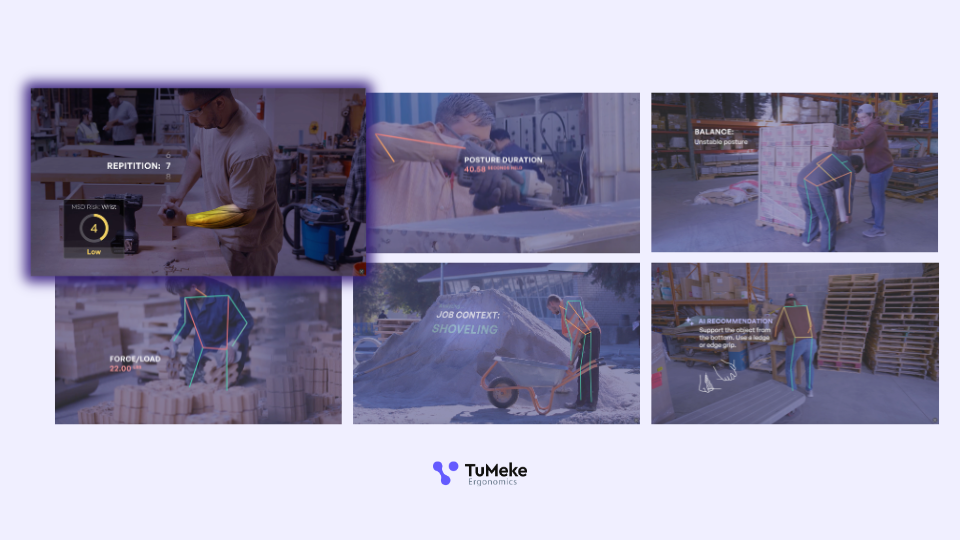
TuMeke helps teams capture that broader picture. Using video-based movement analysis, TuMeke turns real tasks into visible ergonomic risk data that safety, operations, and ergonomics teams can review together.
Instead of relying only on a quick observation, a checklist, or someone’s memory of the task, teams can see how the work actually happens and identify what is driving the risk.
With TuMeke, safety teams can:
The goal is better visibility into real exposure, so safety teams can identify hidden risk earlier and make practical changes before small movement issues become injuries.
See how TuMeke can help your team move beyond posture-only assessments and uncover the real risk behind the work. Book a demo today.
What is posture-only ergonomics?
Posture-only ergonomics focuses mainly on body position, such as bending, reaching, twisting, or overhead work. Posture matters, but it does not show the full risk picture unless teams also consider force, repetition, duration, grip, pace, and task context.
Why can a task look safe but still create ergonomic risk?
A task can look safe during a short observation but still create risk over time. Repeated motion, high grip force, long exposure time, poor handholds, vibration, or limited recovery can create strain even when posture does not look severe.
What risk factors should ergonomic assessments include?
Ergonomic assessments should consider posture, force, repetition, duration, grip, balance, workstation layout, task pace, and recovery time. The right factors depend on the task, but teams should avoid judging risk from posture alone.
How does video-based ergonomic analysis help?
Video-based analysis gives teams a visual record of the task. It helps safety leaders, supervisors, workers, and ergonomists review the same movement patterns, identify the main risk drivers, and discuss practical fixes with less reliance on memory or opinion.
%201.svg)


.jpg)

.jpg)
.jpg)

Key Takeaway
Posture matters in ergonomics, but it does not tell the full risk story. A task may look acceptable during a short observation while still exposing workers to force, repetition, grip strain, fatigue, or long exposure time. That matters because MSD risk often builds across the shift, not just in one frozen moment. To understand real ergonomic risk, safety teams need to look at posture, movement, force, duration, pace, and task context together.
Posture-based assessments have value.
They can show when a worker bends too far, twists through the trunk, reaches overhead, or works outside a neutral position. Those findings matter because awkward posture can increase strain on muscles, tendons, joints, nerves, and the spine.
But posture is only one part of ergonomic exposure.
NIOSH explains that work-related musculoskeletal disorders can be tied to sudden or sustained force, vibration, repetitive motion, and awkward posture. OSHA also identifies risk factors such as lifting heavy items, bending, reaching overhead, pushing and pulling heavy loads, awkward postures, and repetitive tasks in its ergonomics overview.
That is the gap.
A posture snapshot may show what the body looked like during one part of the job. It may not show how often the movement happened, how much force the worker used, how long the task continued, how grip changed, or how the work pace affected recovery.
In real industrial work, those details often change the risk picture.
A worker may lift from a reasonable height with no obvious deep bend or overhead reach. But if that lift happens hundreds of times per shift, with poor handholds and limited recovery time, the task can still create meaningful MSD exposure.
The task did not become risky because posture alone looked extreme.
It became risky because exposure accumulated.
Hidden ergonomic risk often shows up in tasks that look normal at first.
A safety manager may walk past a workstation and see no obvious red flags. The worker is standing upright. The load is not unusually heavy. The reach does not look dramatic. Compared to other jobs in the facility, the task may look controlled.
But the risk may sit in the details:
These are the tasks that can get missed when teams focus mainly on what posture looks like during a quick observation.
NIOSH makes this broader exposure point clearly in its guidance on identifying ergonomic risk factors. It says physical stress comes from the force, repetition, and postures required in job tasks, and that WMSD risk depends on task intensity, frequency, and duration.
That gives safety teams a better question to ask.
Not just, “Does this posture look bad?”
But, “What is the worker exposed to across the full task?”
A task can look acceptable because the riskiest part is not always visible in one moment:
But many MSD risks come from cumulative exposure. The strain builds through repetition, force, duration, pace, poor grip, and limited recovery.
That is why posture-only thinking can create false confidence:
This is where the assessment needs to match the work.
The issue is not whether posture matters. It does. The issue is whether posture alone gives the team enough information to decide what needs to change.
Most of the time, it does not.
Traditional ergonomic tools are not the problem.
Many recognized methods already account for more than posture when teams apply them correctly. For example, the Revised NIOSH Lifting Equation considers load weight, hand location, travel distance, asymmetry angle, lifting frequency, task duration, rest time, and coupling quality.
That is not posture-only ergonomics.
The problem is what happens in practice.
Many safety teams do not have enough time, staffing, or ergonomics support to collect all the task-level details needed for a complete assessment. They may rely on quick observations, still photos, worker interviews, basic checklists, or memory from a walkthrough.
Those inputs can help, but they can leave gaps:
NIOSH also notes that no single checklist fits every situation and recommends collecting task details such as cycle time, motion patterns, tool characteristics, vibration, temperature conditions, and other factors when needed.
That is where many ergonomics programs struggle.
They know the risk is more complex than posture. They just do not always have a practical way to capture the full picture quickly and consistently.
MSD risk is not a small side issue.
In its Elements of Ergonomics Programs, NIOSH cites BLS data showing that work-related MSDs accounted for 29% of nonfatal occupational injury and illness cases involving days away from work.
These injuries affect people first. They can mean pain, restricted movement, missed work, medical appointments, and a harder return to the job. For workers, an MSD is not just a line item on an injury log. It can affect how they sleep, how they move, and what they can do outside of work.
They can also affect staffing, production flow, restricted duty, overtime, workers’ compensation costs, and the credibility of the safety program.
That is why early visibility matters:
The earlier teams can see exposure, the earlier they can prioritize the right correction.
Safety teams need a broader view of the task.
That does not mean every assessment needs to become complicated. It means the assessment should capture the risk drivers that shape exposure.
A stronger ergonomic review should look at:
This helps teams move from general observation to practical decision-making.
Instead of saying, “This task looks okay,” the team can ask:
That might lead to a fixture adjustment, lift assist, tool redesign, workstation change, job rotation, material flow improvement, pallet height control, grip improvement, or pace adjustment.
The goal is not to score the task for the sake of scoring it.
The goal is to find the risk driver clearly enough to act.
Posture is important, but safety teams need more than a posture snapshot to understand how ergonomic risk builds during real work.
TuMeke helps teams capture that broader picture. Using video-based movement analysis, TuMeke turns real tasks into visible ergonomic risk data that safety, operations, and ergonomics teams can review together.
Instead of relying only on a quick observation, a checklist, or someone’s memory of the task, teams can see how the work actually happens and identify what is driving the risk.
With TuMeke, safety teams can:
The goal is better visibility into real exposure, so safety teams can identify hidden risk earlier and make practical changes before small movement issues become injuries.
See how TuMeke can help your team move beyond posture-only assessments and uncover the real risk behind the work. Book a demo today.
What is posture-only ergonomics?
Posture-only ergonomics focuses mainly on body position, such as bending, reaching, twisting, or overhead work. Posture matters, but it does not show the full risk picture unless teams also consider force, repetition, duration, grip, pace, and task context.
Why can a task look safe but still create ergonomic risk?
A task can look safe during a short observation but still create risk over time. Repeated motion, high grip force, long exposure time, poor handholds, vibration, or limited recovery can create strain even when posture does not look severe.
What risk factors should ergonomic assessments include?
Ergonomic assessments should consider posture, force, repetition, duration, grip, balance, workstation layout, task pace, and recovery time. The right factors depend on the task, but teams should avoid judging risk from posture alone.
How does video-based ergonomic analysis help?
Video-based analysis gives teams a visual record of the task. It helps safety leaders, supervisors, workers, and ergonomists review the same movement patterns, identify the main risk drivers, and discuss practical fixes with less reliance on memory or opinion.