


Free 14-Day Trial
Perform unlimited ergonomic assessments for two weeks. All you need is your phone.

Key Takeaway
Most multi-site ergonomics programs fall apart because each site ends up measuring risk a little differently. That makes it hard to compare results or know where to focus. Things start to work when everyone uses the same approach, so leaders can clearly see and manage risk across the entire operation.
A program that works well at one site often delivers quick, visible wins. The team focuses on a few high-risk tasks, uses one method, and documents results in a clear and consistent way.
That early success builds confidence. Then the company tries to repeat the same approach across multiple locations, expecting similar results.
At the original site, the process stays controlled. The same people run assessments, apply the same scoring method, and capture findings in a consistent format.
As the program expands, that control starts to loosen.
Each new site adjusts the process to fit its own reality. Those adjustments seem reasonable, but they introduce variation almost immediately.
At the same time, local priorities begin to shape how ergonomics gets handled.
The work continues, but the approach is no longer consistent from site to site.
Resources and documentation add another layer of drift. Some locations run detailed assessments with clear recommendations. Others capture basic notes in spreadsheets or emails.
Over time, each site builds its own version of the program without realizing it.
These differences may seem small, but they create a serious problem when leaders try to look across the organization. The data no longer lines up in a way that supports clear decisions.
Leaders may have reports from every site, but they can’t compare them with confidence. That makes it harder to:
The issue becomes even more difficult when scoring methods vary. Two sites can evaluate similar tasks and still reach very different conclusions, simply because they used different approaches.
At that point, the company is no longer running one ergonomics program. It’s managing a collection of disconnected efforts.
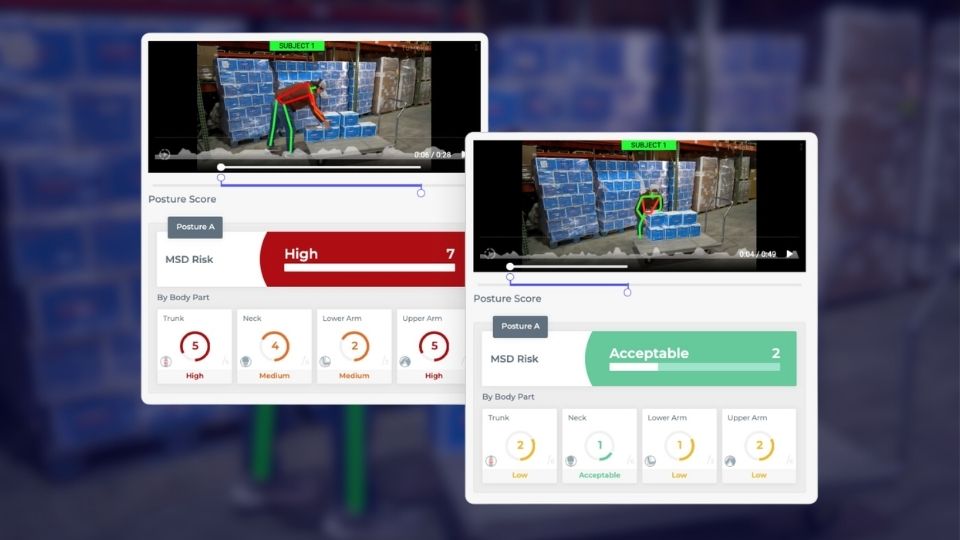
AI and video help standardize ergonomics by making observations more consistent from the start. Instead of relying on memory or quick notes, teams can review the same recorded task and work from a shared visual reference.
That shift alone reduces a lot of variation.
Traditional observation methods depend heavily on who is watching, when they observe the task, and how they document it. Video removes that uncertainty by capturing the full task, so multiple people can review the same lift, reach, or movement and reach more aligned conclusions.
AI builds on that consistency by applying the same scoring logic every time. It reduces the variability that comes from different evaluators interpreting the same task in different ways.
Research supports this direction:
These tools don’t replace expert judgment, but they do create a more consistent baseline for decision-making.
The impact becomes clear at scale. In a multi-site operation, each location may currently assess work in its own way, which makes comparisons difficult.
With a standardized, video-based workflow, every site captures tasks the same way, applies the same evaluation logic, and feeds results into a central system. That gives leaders a clear view of where risk is highest and where action is needed.
This is what makes scaling possible. It’s not about doing more assessments, it’s about making sure every assessment is consistent and comparable.
TuMeke is an AI-driven ergonomics assessment platform built to help companies scale ergonomics across every site, without adding complexity. It replaces inconsistent, site-by-site methods with one standardized system that teams can use anywhere.
With TuMeke, you can:
This is what most programs are missing. Not more effort, but a system that makes every assessment consistent and comparable.
If your team is ready to move from scattered efforts to a program that actually scales, request a demo and see how TuMeke helps you standardize ergonomics across your entire operation.
Why do multi-site ergonomics programs struggle to maintain consistency?
Programs lose consistency when each site uses different assessment methods, tools, and documentation styles. Over time, these small differences create data that can’t be compared, which makes it harder to prioritize risks or manage performance across locations.
What is the biggest barrier to scaling an ergonomics program?
The biggest barrier is the lack of a standardized process. When sites define risk differently or follow different workflows, leaders can’t build a clear, enterprise-wide view of exposure or decide where to focus resources.
How can companies compare ergonomic risk across multiple sites?
Companies need a shared scoring system, consistent data collection methods, and centralized reporting. Using standardized tools and workflows allows teams to evaluate tasks the same way, which makes risk comparisons accurate and actionable.
Why aren’t injury logs enough to manage ergonomics at scale?
Injury logs only show outcomes after harm has already occurred. They don’t capture exposure factors like posture, force, or repetition, which limits their ability to identify risk early or compare jobs across different sites.
How does video-based ergonomic analysis improve consistency?
Video creates a shared, reviewable record of work tasks that removes guesswork. When paired with AI-driven scoring, it ensures each task is evaluated using the same criteria, which helps teams produce consistent data across all locations.
%201.svg)


.jpg)

.jpg)

Key Takeaway
Most multi-site ergonomics programs fall apart because each site ends up measuring risk a little differently. That makes it hard to compare results or know where to focus. Things start to work when everyone uses the same approach, so leaders can clearly see and manage risk across the entire operation.
A program that works well at one site often delivers quick, visible wins. The team focuses on a few high-risk tasks, uses one method, and documents results in a clear and consistent way.
That early success builds confidence. Then the company tries to repeat the same approach across multiple locations, expecting similar results.
At the original site, the process stays controlled. The same people run assessments, apply the same scoring method, and capture findings in a consistent format.
As the program expands, that control starts to loosen.
Each new site adjusts the process to fit its own reality. Those adjustments seem reasonable, but they introduce variation almost immediately.
At the same time, local priorities begin to shape how ergonomics gets handled.
The work continues, but the approach is no longer consistent from site to site.
Resources and documentation add another layer of drift. Some locations run detailed assessments with clear recommendations. Others capture basic notes in spreadsheets or emails.
Over time, each site builds its own version of the program without realizing it.
These differences may seem small, but they create a serious problem when leaders try to look across the organization. The data no longer lines up in a way that supports clear decisions.
Leaders may have reports from every site, but they can’t compare them with confidence. That makes it harder to:
The issue becomes even more difficult when scoring methods vary. Two sites can evaluate similar tasks and still reach very different conclusions, simply because they used different approaches.
At that point, the company is no longer running one ergonomics program. It’s managing a collection of disconnected efforts.
AI and video help standardize ergonomics by making observations more consistent from the start. Instead of relying on memory or quick notes, teams can review the same recorded task and work from a shared visual reference.
That shift alone reduces a lot of variation.
Traditional observation methods depend heavily on who is watching, when they observe the task, and how they document it. Video removes that uncertainty by capturing the full task, so multiple people can review the same lift, reach, or movement and reach more aligned conclusions.
AI builds on that consistency by applying the same scoring logic every time. It reduces the variability that comes from different evaluators interpreting the same task in different ways.
Research supports this direction:
These tools don’t replace expert judgment, but they do create a more consistent baseline for decision-making.
The impact becomes clear at scale. In a multi-site operation, each location may currently assess work in its own way, which makes comparisons difficult.
With a standardized, video-based workflow, every site captures tasks the same way, applies the same evaluation logic, and feeds results into a central system. That gives leaders a clear view of where risk is highest and where action is needed.
This is what makes scaling possible. It’s not about doing more assessments, it’s about making sure every assessment is consistent and comparable.
TuMeke is an AI-driven ergonomics assessment platform built to help companies scale ergonomics across every site, without adding complexity. It replaces inconsistent, site-by-site methods with one standardized system that teams can use anywhere.
With TuMeke, you can:
This is what most programs are missing. Not more effort, but a system that makes every assessment consistent and comparable.
If your team is ready to move from scattered efforts to a program that actually scales, request a demo and see how TuMeke helps you standardize ergonomics across your entire operation.
Why do multi-site ergonomics programs struggle to maintain consistency?
Programs lose consistency when each site uses different assessment methods, tools, and documentation styles. Over time, these small differences create data that can’t be compared, which makes it harder to prioritize risks or manage performance across locations.
What is the biggest barrier to scaling an ergonomics program?
The biggest barrier is the lack of a standardized process. When sites define risk differently or follow different workflows, leaders can’t build a clear, enterprise-wide view of exposure or decide where to focus resources.
How can companies compare ergonomic risk across multiple sites?
Companies need a shared scoring system, consistent data collection methods, and centralized reporting. Using standardized tools and workflows allows teams to evaluate tasks the same way, which makes risk comparisons accurate and actionable.
Why aren’t injury logs enough to manage ergonomics at scale?
Injury logs only show outcomes after harm has already occurred. They don’t capture exposure factors like posture, force, or repetition, which limits their ability to identify risk early or compare jobs across different sites.
How does video-based ergonomic analysis improve consistency?
Video creates a shared, reviewable record of work tasks that removes guesswork. When paired with AI-driven scoring, it ensures each task is evaluated using the same criteria, which helps teams produce consistent data across all locations.
.jpg)